
INTRODUCTION
I will be exploring a bank marketing dataset, specifically focused on evaluating the effectiveness of telemarketing campaigns by a Portuguese bank. The classification goal is to predict whether a client will subscribe to a term deposit. There are four versions of the dataset, each containing information on bank clients, last contact details, additional attributes, and social and economic context. These variables offer valuable insights into various factors influencing the success of the telemarketing efforts.
ASK
Task: Perform analysis of bank telemarkiting data to determine whether a client will subscribe to a term deposit.
Primary Stakeholders:
- Executive Team
PREPARE
DATASET OVERVIEW
- Research on a Portuguese bank’s telemarketing effectiveness.
- Data collected from 45,211 instances of consumer interactions.
- Marketing campaigns conducted via phone calls (cellular or landline).
- Data contains 20 variables.
VARIABLES INCLUDED
- Client details: Age, job, marital status, education level, bank balance.
- Credit info: Defaults in credit, housing loan, personal loans.
- Telemarketing specifics: Number of contacts, timing, duration.
- Effectiveness info: Time between contacts, previous campaign outcomes.
- External factors: Employment variation rate, consumer price index, consumer confidence index, and Euribor 3-month rate.
- Outcome variable (Y): Whether the campaign led to a client subscribing to a term deposit (Yes/No).
DATA ANALYSIS GOALS
- Filter data to identify important variables related to term deposit subscription.
- Compare successful campaigns with unsuccessful ones.
- Focus on age and balance variables to explore correlation with campaign success.
- Investigate the relationship between housing status and marital status for term deposit subscription likelihood.
- Aim to identify the best target demographic based on the relationship between age and account balance.
PROCESS
Import pandas library, and assign a variable to the CSV name. Then utilize a method from the Pandas library to create a dataframe for the CSV file.
Python Scripts
FIG. 1

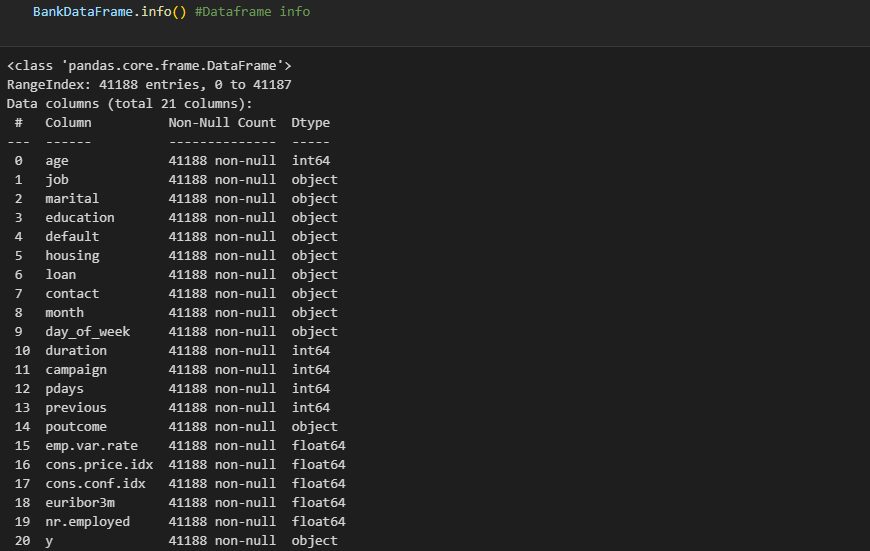
I use the Pandas method "info()" to get details on the data type of each column in the dataset. Understading the data type and the data set is important for any data cleaning and/or manipulation that may occur during prior to analysis.
FIG. 2
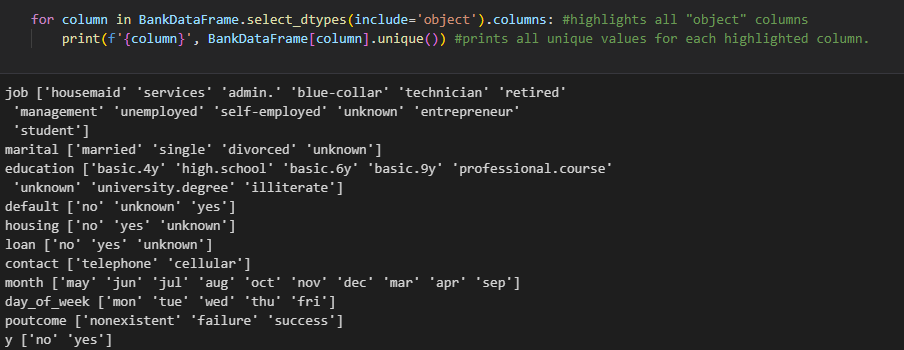
Given this data is based on Telemarkting "survey" data, there is a strong possibility of variations of the same answer.Example May vs may. This typically occurs if answers to questions are typed in rather the pulled from a drop down. In order to determine if there were variations of the same answer and all possible answers in the data set I it used a for loop to iterate through each object data type in the data set. Upon printing the results I utilized the unique method to pull only distinct values from each column.
FIG. 3
DATA ANALYSIS
- Does age of client correlate with term deposit subscriptions?
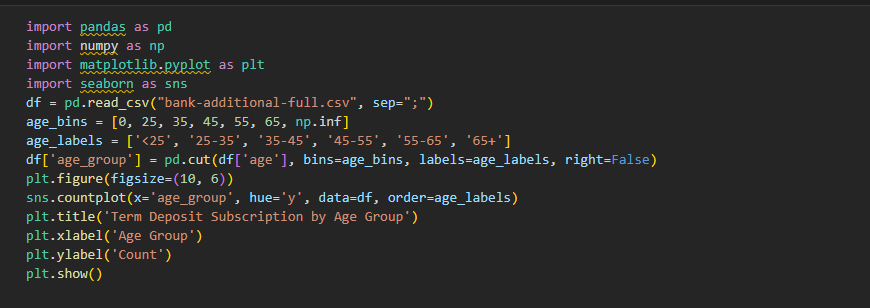
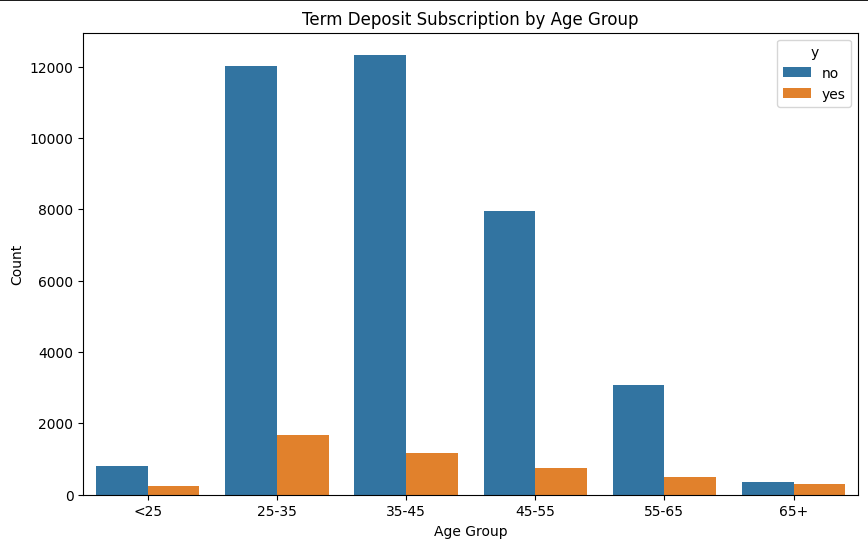
Figure 1 and 2: The provided code generates a visual representation of term deposit subscriptions segmented by age groups, offering valuable insights into our current standing and illuminating pathways for strategic enhancement. Upon analysis, it becomes evident that three age brackets, namely '25-35', '35-45', and '45-55', significantly dominate the user base. Regrettably, these age groups also exhibit the lowest subscription rates relative to their respective populations.
In contrast, the 65+ age group demonstrates a near-even split between users and subscribed members. Similarly, within the "less than 25" age group, approximately 75% of users remain unsubscribed, while around 25% have opted for subscription services.
These findings serve as strategic directives, indicating that despite constituting the majority of users, the '25-35', '35-45', and '45-55' age cohorts present untapped potential for subscription conversion. By tailoring our marketing initiatives to better resonate with these specific demographics, we stand to significantly augment our subscriber base and overall campaign effectiveness.
FIG. 1 and FIG. 2
- Are there any specific months that correlate with increased term deposit subscriptions?
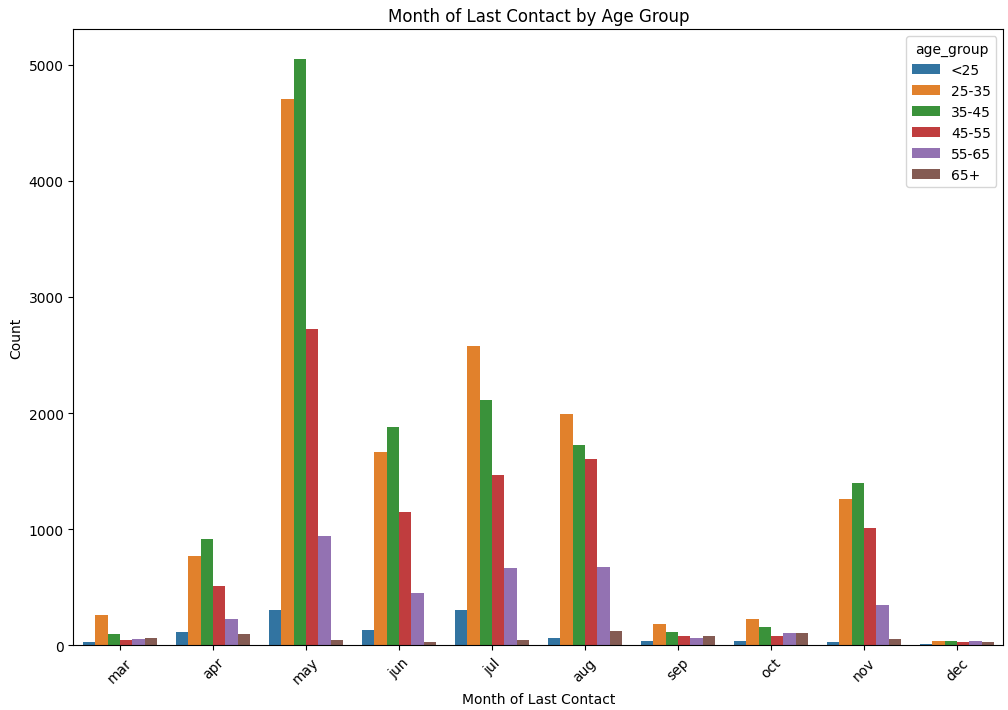
Analyzing the chart presented below, it becomes evident that May stands out as the month with the highest contact rate. Additionally, notable is the stark decline in contact during March, September, October, and December, suggesting these months are least conducive for subscriber engagement. Statistically, the optimal window for conducting successful sales pitches spans from May through August.
Taking cues from both visuals, it's apparent that to optimize the upcoming subscription campaign, a summer-focused approach targeting individuals aged 25-55 is warranted. This strategic alignment ensures the campaign's efficacy by capitalizing on peak engagement periods and focusing on the demographic segments most receptive to our outreach efforts.
FIG. 3

- Are there any distinct days of the week that are best for contacting our key age demographic?
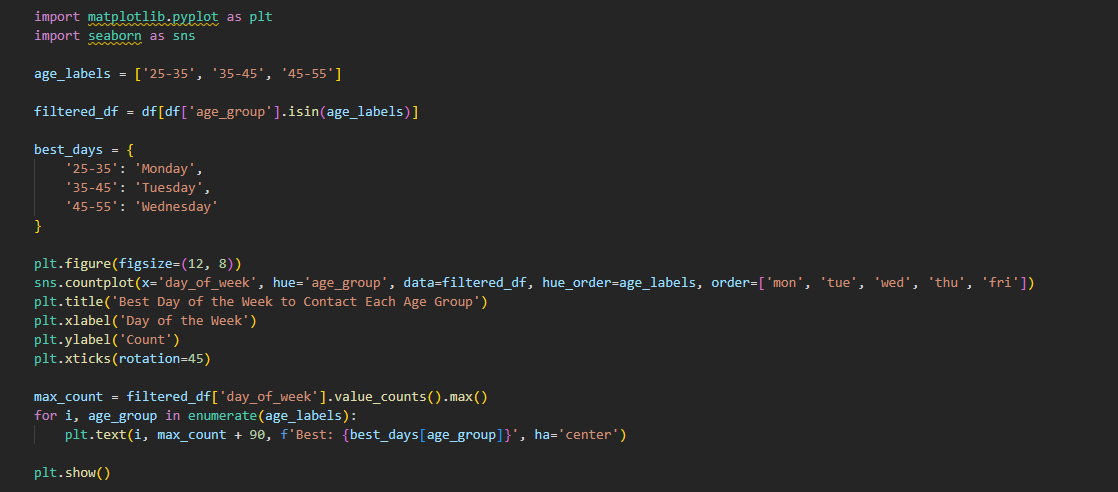
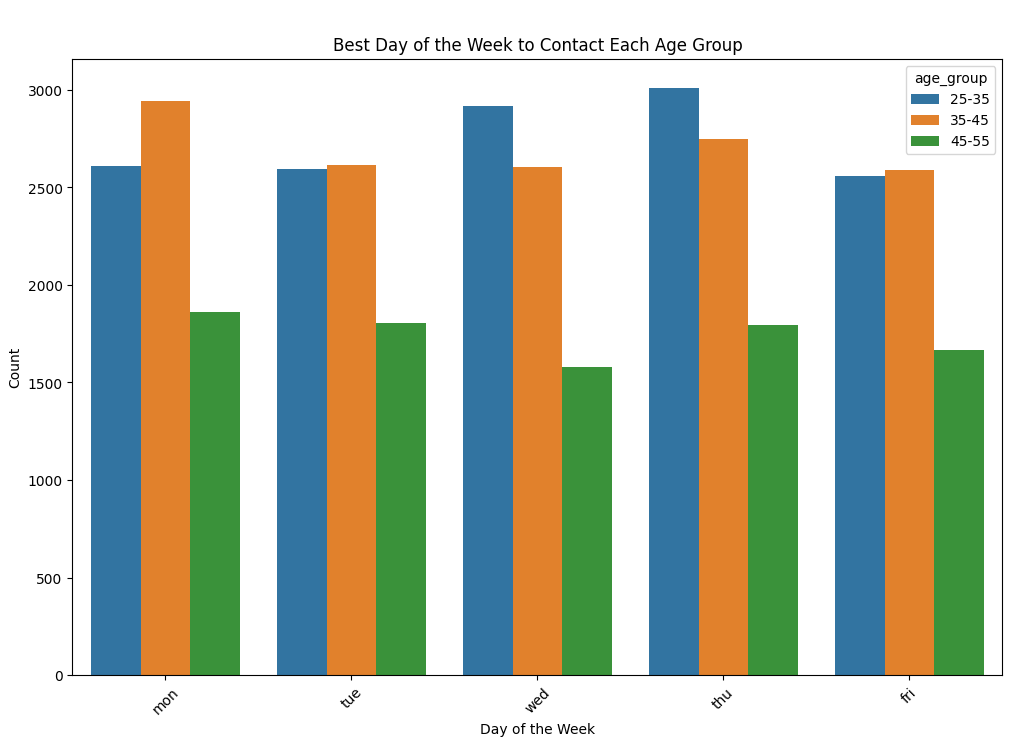
Based on the information gathered, launching a summer campaign targeting specific age groups: 25-35, 35-45, and 45-55 to optimize our outreach strategy would be best. To further understand if there are specific days that best lead to term subscription, we looked at count of term subscriptions based on day of the week for our subset of age ranges.
For the 25-35 age group, Wednesdays and Thursdays are the most effective days. For the 35-45 age group, Mondays and Thursdays yield the best results. And for the 45-55 age group, Mondays and Tuesdays are the optimal days. This strategy leaves Fridays, as the day to reach out to individuals outside our targeted age groups. By implementing this approach, we aim to maximize our outreach to the largest demographic segments during the peak season, ensuring a successful campaign.
FIG. 3
ACT
Analysis based conclusion
- Individuals in age range of 25-35, 35-45, and 45-55 were most likely to subscribe to a term deposit.
- Month range of May through August are most optimal for conducting successful sales pitches.
Recommendation
In analyzing the likelihood of clients subscribing to a term deposit, we found that individuals in the age range of 25-35, 35-45, and 45-55 are the most likely to do so. Making them our target demographic. This age range for marketing efforts is important. A 30-year window during which individuals are making long-term financial decisions. Many in this group are at a stage in life where investing for the future is both relevant and beneficial, making them more receptive to financial products like term deposits.
Marketing towards these groups via the major social media outlets such as instagram and twitter in which we can showcase the benefits of subscribing to a term deposit. Followed by an increase in campaign outreach during the months of May through August.
Providing an incentive to those who make their first term deposit with the bank by giving customers a slightly decreased withdrawal penalty during their first 6 months banking with us.
REFERENCES
- Roy, S. (2019). Predicting Success of Bank Telemarketing. GitHub. Retrieved from https://github.com/sukanta-27/Predicting-Success-of-Bank-Telemarketing
- Moro, S., Cortez, P., & Rita, P. (2014). A data-driven approach to predict the success of bank telemarketing. Decision Support Systems, 62, 22-31. https://doi.org/10.1016/j.dss.2014.03.001 /